THE CREATIVE PROCESS - PART 3

“I have a terrible clarity of mind at times, when nature is so lovely these days, and then I’m no longer aware of myself and the painting comes to me as if in a dream.”  from a letter by Vincent Van Gogh to his brother Theo, 25 September 1888

The beautifully lyrical writing of Van Gogh brings us to the next stage of the creative process. This is what creativity and innovation consultant, James Taylor, describes as the moment of insight:

“The third stage is what most of the public think is a classic signal or sign of a creative person, what is called the INSIGHT stage . . . it is really the idea of the ‘Aha’ moment, the ‘Eureka’ moment. Although it is probably the smallest part of the five steps, it is possibly one of the most important parts.”

The question then could be: Is there something I can do to experience insight? 

For transcendentalist, Henry David Thoreau, it required living alone in the woods on the shores of Walden Pond: 

 “I learned this, at least, by my experiment; that if one advances confidently in the direction of his dreams, and endeavors to live the life which he has imagined, he will meet with a success unexpected in common hours. He will put some things behind, will pass an invisible boundary; new, universal, and more liberal laws will begin to establish themselves around and within him; or the old laws be expanded, and interpreted in his favor in a more liberal sense, and he will live with the license of a higher order of beings.” from Walden

The moment of insight often comes during periods of solitude, in the early waking hours of the day, or while walking or running; but it can also happen during conversations in neighborhood cafés, and in cities where synergy is produced by artists gathering together to share ideas and studio space. In any environment that is well suited to our individuality, inspiration can suddenly appear giving birth to the creative act, if we are attentive to its voice.

As Erwin Raphael McManus explains, “The creative act is a manifestation of imagination. Everything that exists began as an idea; everything we define as reality began as nothing more than imagination. Reality exists because it was first imagined. In fact, everything we know about the invisible comes to us in the form of the visible.” from The Artisan Soul

I hope you experience a moment of insight this week, and bring forth something visible from the invisible that you can share with others, and enrich their lives through your creativity.
THE CREATIVE PROCESS - PART 2

Incubation is the process of incubating, which is, maintaining conditions favorable for promoting development. Most often, this refers to the incubating of eggs laid by a mother bird or hen. In the creative process, however, it means fostering conditions favorable to the development of the fine art product.

Two of the definitions of fine art are:

(1) Creative art, especially visual art, whose products are to be appreciated primarily or solely for their imaginative, aesthetic, or intellectual content;

            (2) An activity requiring great skill or accomplishment.

Clearly, the hatching of baby birds and the process of painting, printmaking or photography are fine art. Both require a great deal of skill, patience, and perseverance, with hope that the unseen product will become visible at some time in the future, yielding a degree of aesthetic satisfaction and enjoyment.            

During the incubation period, I am often unaware of what triggers the contemplation of the details of a piece I have not yet begun, such as, the size of the work, the medium to be used, or the color palette. However, as the project begins to take shape in my mind, images are collected, and details written on my phone, in a notebook, or on a coffee shop napkin. Some ideas are later used; many are discarded.  

As James Taylor suggests,  “It can takes days, or weeks, or months or sometimes even years . . . you’ll think about writing about a book or piece of music, and you’re writing about it and you just leave it to the side for a while, and then you come back to it. Now the interesting thing about the incubation stage is that to a certain extent it is not really under your control how long that stage will take.”

I think the important part of this stage of the creative process is found in the definition of incubation: maintaining conditions favorable to promoting development. It’s interesting to note that the origin of the word comes from the Latin, incubare, and means to lie or recline on. And, this part of the process may literally mean taking time out from daily activities to find that place of peace and tranquility, and allowing yourself time to meditate, to ponder, to muse—to pray.

“Who has the wisdom to count the clouds?” from the Book of Job

THE CREATIVE PROCESS - PART 1

According to creativity expert, James Taylor, the five stages of the creative process include: preparation, incubation, insight, evaluation and elaboration.

And while these stages are not linear, but iterative in nature; having a plan can be very helpful to the artist; especially, those of us who tend toward an abstract random personality type, preferring to function in highly personalized and flexible environments.

So, let's look at the first stage in Taylor's hierarchy: Preparation.

"[T]he idea that you are immersing yourself in the domain. If you are a musician you are absorbing a lot of the music that is inspiring you to create this new piece. if you're a writer you are reading other writers in this area. If you are an artist you are looking at other artists' work in the area that you are creating something in. . . ."  Perhaps.

Or perhaps, it is something else.

I like to ask myself the question that I will ask you: What inspires you?

Is it looking at other artists' work or looking at the world that surrounds us? Sometimes, it can be an impression in our spirit beyond what we see, that calls for expression in the earth.

For me, it’s all of these. There is an appreciation for other artists’ work, a fascination in the complexity of the human condition in the world, and a breath-taking sense of joy found in the beauty of nature.

“To go into solitude, a man needs to retire as much from his chamber as from society. I am not solitary whilst I read and write, though nobody is with me. But if a man would be alone, let him look at the stars. The rays that come from those heavenly worlds will separate between him and what he touches. One might think the atmosphere was made transparent with this design, to give man, in the heavenly bodies, the perpetual presence of the sublime. Seen in the streets of cities, how great they are! If the stars should appear one night in a thousand years, how would men believe and adore; and preserve for many generations the remembrance of the city of God, which had been shown! But every night come out these envoys of beauty, and light the universe with their admonishing smile.” 

from Nature by Ralph Waldo Emerson

(To be continued)

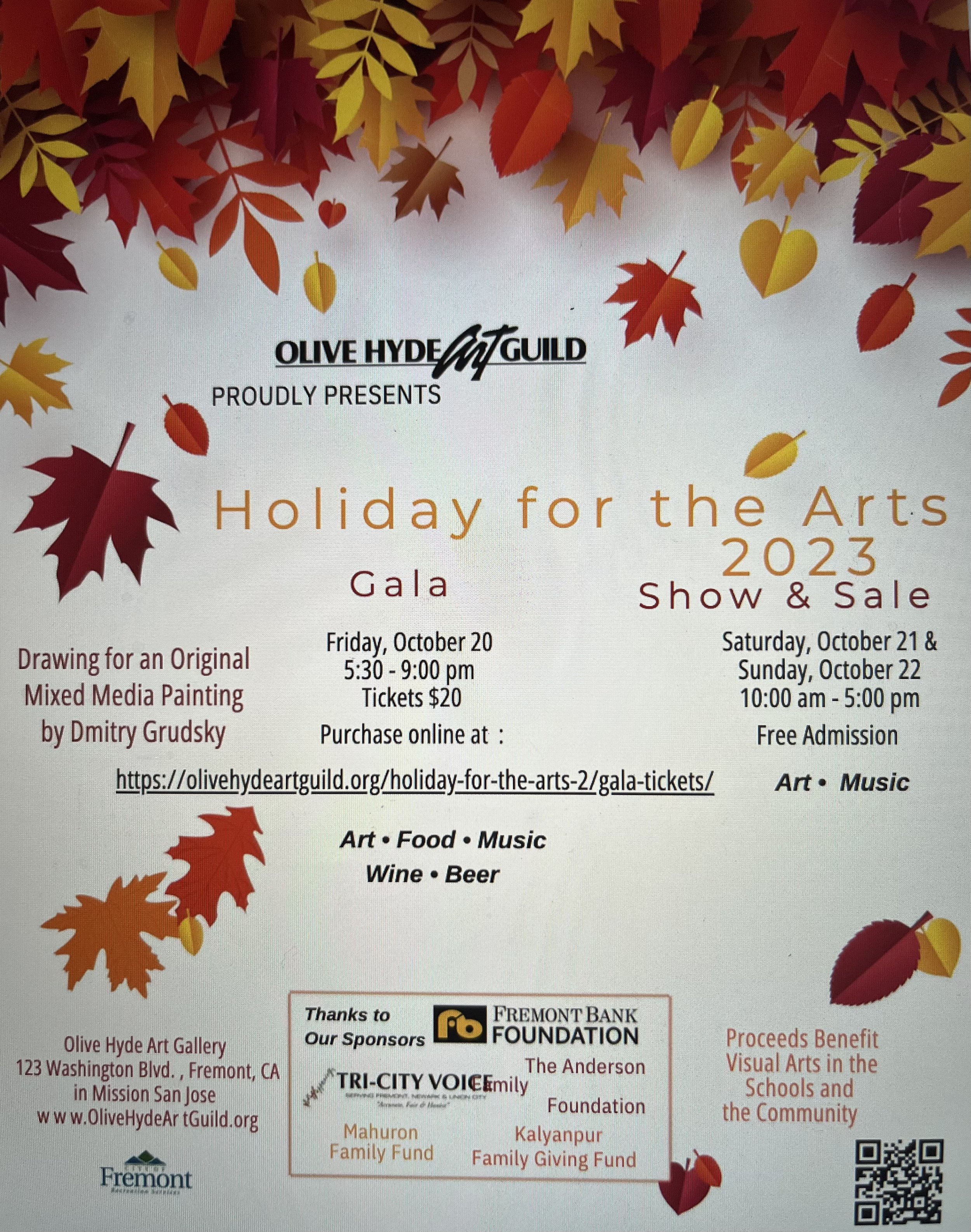
Holiday for the Arts

SUNRISE and MOON RISING are on exhibit and for sale at the Olive Hyde Art Gallery along with other original art work and crafts by local artisans. Stop by and purchase holiday gifts for family and friends as you support our Fremont gallery.